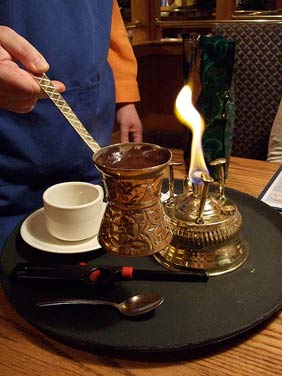
Anyone who has been to Balkans or Near Eastern restaurant has probably tried that little cup of caffeine often presented as Turkish, Greek, Byzantine, Serbian or Armenian coffee. The nationalistic associations aside, coffee functions as the main catalyst of conversation in the former territories of the Ottoman Empire. In these areas, coffee can be consumed at any hour and social circumstance, it functions as a soft drink or a beer would in western societies. In doing so, the coffee itself is subject to numerous traditions and ceremonies generated for centuries in these societies. Amongst these ceremonies, I would like to examine today the act of tasseography, or as it is more commonly known, the act of coffee fortune telling.
Usually coffee is consumed in a social context with more than two people present. When the coffee is completely consumed, the remnants of the brewed coffee remain at the bottom of the cup. This is often called the "mud" or the "clay" at the bottom of the mug. The act of fortune telling often begins with one person taking the role of the fortune teller and the other of the listener. These roles are mutually assumed and are performed within the enchanter/enchanted dichotomy, the "real" power relations inherit between the fortune teller and the listener are discarded under the contract of mutual fortune telling. This contract is implicit and is never mentioned, however the application of the contract often begins with the enchanter uttering something similar to "so let us take a look your kismet." From this point onwards, the ceremony of fortune telling has begun.
The enchanted performs an act (slightly different in every locality) of "enchanting" the coffee cup with a series of pre-defined motor functions and then sets the coffee to rest upside down on a saucer in front of the fortune teller. After a few minutes, the "kismet" of the enchanted is ready, the coffee cup is removed from the saucer and the fortune is revealed. What is said as fortune is very interesting, as usually taboo conversation subjects such as sexuality, relations and monetary affairs can be "discussed" under the guise of fortune telling. The private sphere of the individual can be discussed as the social power structures are cast aside in the act of tasseography. Quite often, the unspeakable is spoken in guise, for example if the fortune teller has some sort of sexual or emotional ambitions towards the enchanted, these can be uttered through phrases such as "I see someone in your near future" or "Someone in your near future will make you very happy." Or if the enchanter wants to warn the enchanter about a third party, this can also be done through this ceremony. So basically, the tasseography functions as a social contract through which both parties can comment on the private affairs of each other.
Naive sounding as it is, fortune telling still plays a huge role in both rural and urban environments. It provides a medium through which social taboos can be sidestepped through a play acting sequence. So next time someone offers to read your fortune, listen carefully to what they say. As we say in Turkish, "one cup of coffee keeps a good memory of 40 years."


 Posts
Posts


