Showing posts with label Greece. Show all posts

Saturday, December 13, 2008

Gyros makes the world go 'round


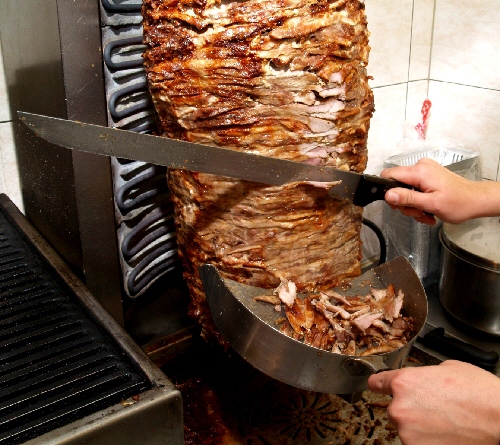
I love Gyros. I love sultry, salty, succulent meat turning on a spit. Shave it and wrap it in fluffy, delicious pita. I love it with tzatziki or spicy feta spread.  I love it with tomatoes, french fries, and onions.  But what I don't love is the fake unpalatable wrapped trash passed onto unwitting American consumers. This is not to say that sometimes it can't be tasty - I've definitely filled up on the American version at the Gyros House in St. Louis. Papa Cristo's in LA has also done it's job from time to time. But generally it needs to be noted that what Greek-American restaurateurs serve would never pass in Greece.

Before I launch into any tirades concerning fast food of the Eastern Mediterranean, it must be made clear that I will focus exclusively on the Greek version of gyros.  Many permutations exist throughout the Mediterranean world, primarily as Döner and as Schawarma.  The modern inculcation first appeared in the 19th century, in the Turkish city of Bursa and quickly spread to other parts of Turkey.  Greeks expelled from Turkey in the 1960's began opening up döner shops in their new country, and quickly popularized döner, which was rebranded as gyros (Greek for "turning").  With fast-food culture taking over the Western world, Greek expatriates living in the United States returned and established a fast-food tailored to Mediterranean tastes.

The American gyros can be looked at as a metaphor for Greek diaspora culture - or it can be further extrapolated as a prime example for any diaspora. Clearly Greek entrepreneurs meant well when they popularized gyros but they had to tailor it to not only American tastes but also to American preconceptions and stereotypes with regards to Greek culture. Certainly in the 1960s the stereotypes of a pastoral Greece, whose landscape was dominated by shepherds and their flocks of sheep and goats, wasn't too far-fetched. What stuck in the imaginations of Americans were images of Greece, which were filtered through the lens of the few prominent films which caught the attention of the general public - Never on a Sunday and Zorba the Greek, serve as two prime examples. I will not discuss these films in depth but they both establish and corroborate the stereotype of the macho mustachioed Greek man, drunk, poor, dancing, and happy.

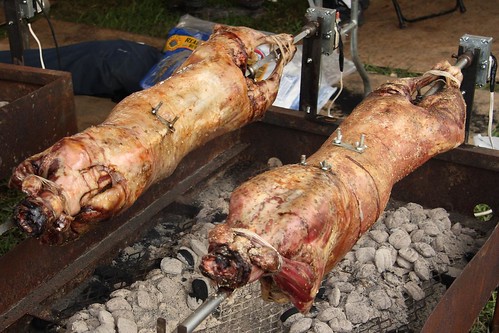
In all of this developed this fascination with Lamb. According to the average American, Greeks eat lamb for every meal. While I love lamb, until relatively recently, the cuisine of Greece was purely seasonal. You could not buy strawberries in November. You could buy lamb frozen but that simply would not do. Lamb really is only served a couple of times a year - served primarily at Eastern when it is roasted whole on a spit, preceded by an intense soup made with the offal of said lamb.

These misconceptions are played up by Greek-American restauranteurs who, at this point are run by 2nd, 3rd, and 4th generations who have been fully assimilated into American culture, and are perpetuated in the name of sales and expectations of the American clientele. Certainly most emphasize quality of ingredients but very few emphasize refinement of cooking. Often it is an older family member who cooks the traditional dishes and recipes, which are passed on to line cooks who are often not Greek. But essentially this is comfort food - from their home to yours and is not intended to be a refined cuisine.

Of course this article is not intended to belittle the hard work of Greek-American restaurateurs who have worked hard, chasing the American dream. The true testament to these entrepreneurs are the legions of Greek-Americans who have excelled in academia, medicine, law, business, etc. The only question that remains is - if this group of people can excel in so many high-profile fields, why can't they just serve a proper Greek gyro?

Thursday, December 11, 2008

Come All Ye Faithful


On Saturday I'm headed to Greece. As you may have heard, the entire country has erupted into riots over the shooting of a 15 year old boy by Greek police; the rioting that ensued thereafter was the culmination of dissatisfaction with the Greek economy and the quality of life under the current governmental administration. Obviously the situation has deteriorated far more precipitously than anyone had anticipated - hence the Christmas tree decked out in its holiday finest in front of the Greek Parliament building in Athens.

Ivo wanted my cousin, George to live-blog as the various events unfolded while he and his university compatriots took to the streets in protest but, unfortunately he wasn't so keen on the idea. Had we been in Greece this week instead of next I certainly would have taken the opportunity to at least provide some better insight on what exactly is going on at the street level beyond the handful of anarchists throwing molotov cocktails.

This said, I wanted you dear readers to know that for the next 30 days this blog will be heavily influenced on experiences abroad. I hope to bring you insight on Greek wine from the region of Naoussa, an introduction to the wonderful world of Ouzo, a variety of traditional Greek and Turkish recipes, and an expose on some of the best Gyros that one can find in the world. Dear readers, I hope to take you on a virtual vacation. To experience with me the sounds, sights, and smells (well not really) of travel in foreign destinations. Meanwhile I'll try to dodge the flying stones and puddles of burning gasoline.

Sunday, November 16, 2008

From a Cemetery on a Hill

Cemeteries have always intrigued me. When I was a small child, my grandmother and I would visit the grave of my great grandmother, located in a small, overgrown patch of land near the Greek-Macedonian border. The hot dry summer grass swayed gently in the wind and on the way home we would pilfer figs from overhanging trees and enjoy their sweet. St. Louis definitely is not Greece, but those early experiences amongst gravestones and family plots spurred an appreciation for the solitude and peacefulness of cemeteries. I was always fascinated by the fact that I was standing on top of a buried body and I would often fantasize about the lives of the interned, looking at the dates of birth and death to try and read clues about how or why these people passed away. 

St. Louis' Calvary and Bellefontaine Cemeteries, located on the North Side, just west of the intersection of N. Kingshighway and W. Florissant, are both exceptional places as far as cemeteries are concerned; after all, nothing particularly exciting happens at cemeteries. A number of impressive heavyweights are interned here, including William Tecumseh Sherman, William Clark (of Lewis and Clark fame), Dred Scott, William S. Burroughs, Adolphus Busch, as well as the mausoleum of the infamous Lemp family. A veritable collection of who's who in St. Louis society.  

The Eternal View
The cemeteries, situated on a hill, command a sweeping view of heavy industry - the landscape below is dominated by warehouses and tractor trailers. St. Louis' wealthiest families are not interned adjacent to this industrial landscape but these cemeteries are also located among some of the most economically blighted neighborhoods I've ever visited. 

While one looks out over the vast landscape of trees, warehouses, electrical lines, and tractor trailers one notices something puzzling about the environment. HARK! What is the divine sweet smell that wafts through the air as one wanders about, admiring mausoleums and obelisks? It is not the sweet smell of death but rather the sweet smell of Wonder Bread and Hostess Twinkies!

At some point when I was a child, I was lucky enough to visit Interstate Bakeries Corporation factory and have been forever mesmerized by the incredible scents that emanate from the industrial complex. The whirring machinery and conveyors, which send loaves of perfect, factory-made white bread flying by at various stages of production, made an indelible impression on my 6 year old self. This was the equivalent of visiting Willie Wonka's Chocolate Factory if only he had chosen yeast and flour over high fructose corn syrup. The scents of these industrially produced baked goods are so strong that a stiff wind carries them miles away. Heaven!

This incongruity between landscapes is highlighted further by this synesthetic experience, which combines the visual with the olfactory. Bucolic rolling hills are ravaged by poverty and manufacturing.  River vistas have given way to industrial landscapes. And the smell of death is truly sweet here. The experience one can have at Calvary and Bellefontaine Cemeteries highlights and epitomizes one's life in St. Louis. Life here is never what it seems to be.

Monday, October 27, 2008

Column: Deep Culture: Ivo Furman

I often find introductions difficult to write, as they must introduce a body of work that has not been written let alone defined. When Max Holtz contacted me about the possibility of writing a column for his blog, I tried to conceptualize how my vocation and my hobby would coalesce. Being a PhD researcher in the UK, I felt that I had to combine my study of sociology with the themes Max wanted to explore. I hope to do this without being too pedantic as most academicians are when it comes to writing popular articles. So, I'll try writing jargon free and using personal references suitable for an international audience.

This column will essentially deal with the sociology of food, with how food is a medium of identification. When we talk about food as a conversation topic, it often serves an indicator of our lifestyles, ethnic background and even our political identity. In doing so, food is an individualized act of consumption in which every possible combination has a particular rationality and order. On the other hand, food is universal; it is the collective act of feeding for subsistence. I will be using the latter of the two definitions for this column. Among the topics will be covering will be issues such as how societies and cultures create the "myth" of cuisine around food, how ideas of nationalism categorize food and how the fetishization of cuisine leads to a transformation from necessity to commodity in urban environments. Lastly, I will also be exploring the relation between sexuality and cuisine in national cultures.

Next week, I will be writing a short article about coffee nationalism(s) in South Eastern Europe. In this area of the world, the same cup of coffee is either a Bosnian, Serbian, Croatian, Greek or Turkish coffee depending on your political perspective. Therefore in a political context, coffee is a metaphor for the problematic of Balkan identity and nationalisms.

I hope that this article serves as a delineation of the issues I wish to address in this column. I will finish off this short introduction with a Korean proverb I often like to quote as a toast to the culture of food: "the deeper the culture the tastier the food."

Ivo